

Water damage doesn’t end when the visible water disappears. After a flood, leak, or plumbing failure, hidden moisture can linger deep in walls, floors, and structural materials — leading to mold, odors, and structural deterioration if not properly dried. That’s why professional water damage restoration relies on specialized equipment designed to speed drying, remove moisture, and monitor progress. In this guide, we break down air movers, dehumidifiers, and moisture monitoring tools — explaining what they are, how they work, and why they are essential to successful restoration.
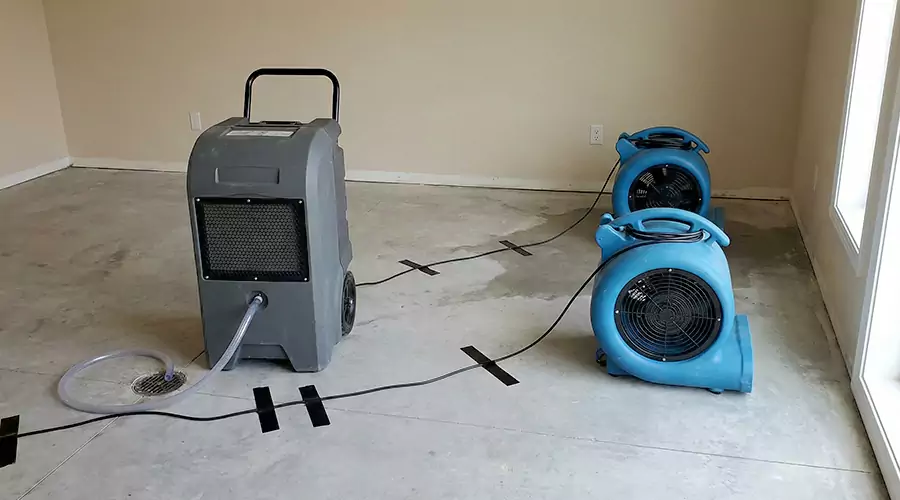
Air movers are industrial‑strength fans that produce concentrated, high‑velocity airflow to accelerate evaporation of moisture from wet surfaces such as drywall, wood, carpet, and ceilings. They are far more powerful than ordinary household fans and are designed specifically for restoration work.
Professional restoration crews place multiple air movers around affected areas to create continuous airflow patterns that:
Without air movers, drying relies on slow natural evaporation — a process that can take weeks and may never fully remove moisture from deep within materials. Quick, directed airflow reduces drying times and lowers the risk of secondary damage like mold growth and structural warping.
A dehumidifier is a machine that removes moisture from the air. In restoration work, high‑capacity units are used to control humidity and allow evaporation to continue once the moisture has been lifted into the air by air movers.
Once air movers evaporate moisture into the air, humidity would rise and evaporation would stall without a dehumidifier. By continuously pulling moisture out of the air, dehumidifiers help keep humidity low, enabling fast, complete drying of materials and preventing mold growth.
Simply running air movers and dehumidifiers is not enough — you need data to confirm that drying is complete and no hidden moisture remains. Moisture monitoring tools help restoration professionals:
Moisture meters measure the moisture content in building materials (wood, drywall, concrete) using sensors that detect electrical resistance or dielectric properties. These readings determine whether materials are still damp and when they’ve returned to normal levels.
These devices measure relative humidity (RH) and temperature in the air — crucial for understanding how well the environment supports drying. Recording humidity and temperature helps technicians adjust dehumidifiers or equipment placement for optimal conditions.
Moisture mapping involves taking systematic readings across a grid in the affected area and creating visual charts that show where moisture is still present and how it changes over time. This helps ensure complete and uniform drying.
The drying process is a coordinated system:
Without air movers, evaporation is slow. Without dehumidifiers, humidity rises and stops evaporation. Without moisture monitoring, you can’t confirm whether drying is truly complete. Using professional 24 7 Restoration services ensures efficient, measurable structural drying — protecting property from secondary damage and ensuring safe restoration.
Professional water damage restoration relies on more than just extracting standing water — the key to successful recovery is controlled drying. Air movers kickstart evaporation, dehumidifiers extract moisture from the air, and moisture monitoring tools confirm true dryness. By using all three together, restoration specialists ensure a thorough, fast, and effective drying process that prevents mold, preserves building materials, and supports insurance documentation.
Our certified experts are ready 24/7 to assist you with emergency restoration services.
GET A QUOTE